Vector vs. embedding — what's the real difference?
· article · 2 min read · ai · embeddings
Imagine this: you and your friend decide to create a new recipe for a chocolate fudge cake together.
You start by writing down all the ingredients — flour, sugar, cocoa, butter, eggs — and their exact amounts. This list is precise and detailed. It's like a recipe in numbers.
Your friend, a pastry chef, thinks about not just the ingredients but how they will come together — the rich chocolate flavour, moist texture, and indulgent feel of the cake. She sums it up into a compact description that captures the essence of what the cake will be like.
Simply put:
- Your ingredient list is like a vector. It is raw data, detailed and straightforward.
- Your friend's summary is like an embedding. It is a meaningful, learned representation that captures the relationship and context behind the raw data.
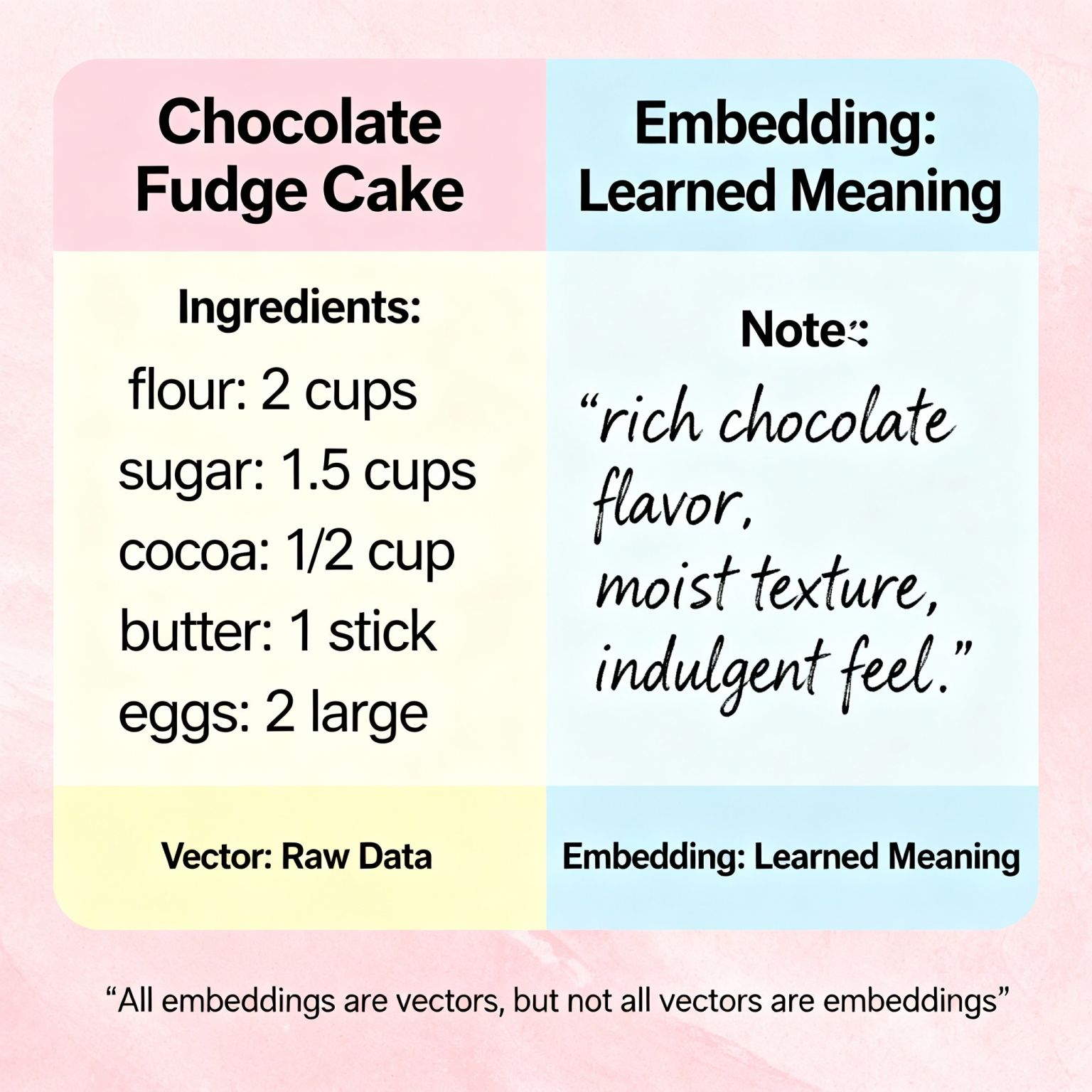
It's important to remember that all embeddings are vectors, but not all vectors are embeddings. Embeddings are special vectors learned by AI to capture meaning and relationships. Vectors can be any numerical list representing data.
Now here's where AI comes in. AI models, often deep neural networks, generate these embeddings by processing data such as text or images and turning them into compact numerical codes. These embeddings live in a high-dimensional space where similar meanings or features cluster close together.
This helps AI understand and find things that feel similar, even if their raw data looks different.
That is the magic behind smarter search, recommendation systems, and modern AI applications.
Originally posted on LinkedIn.